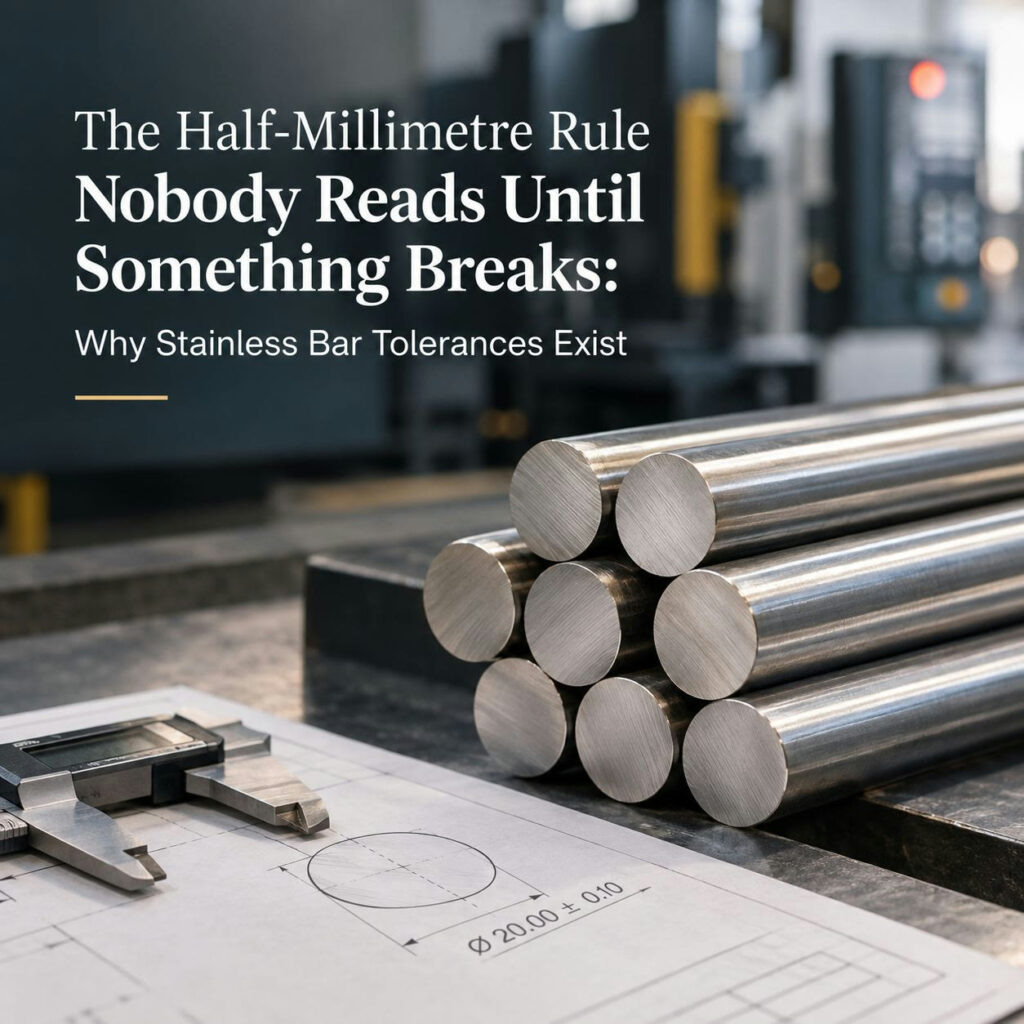
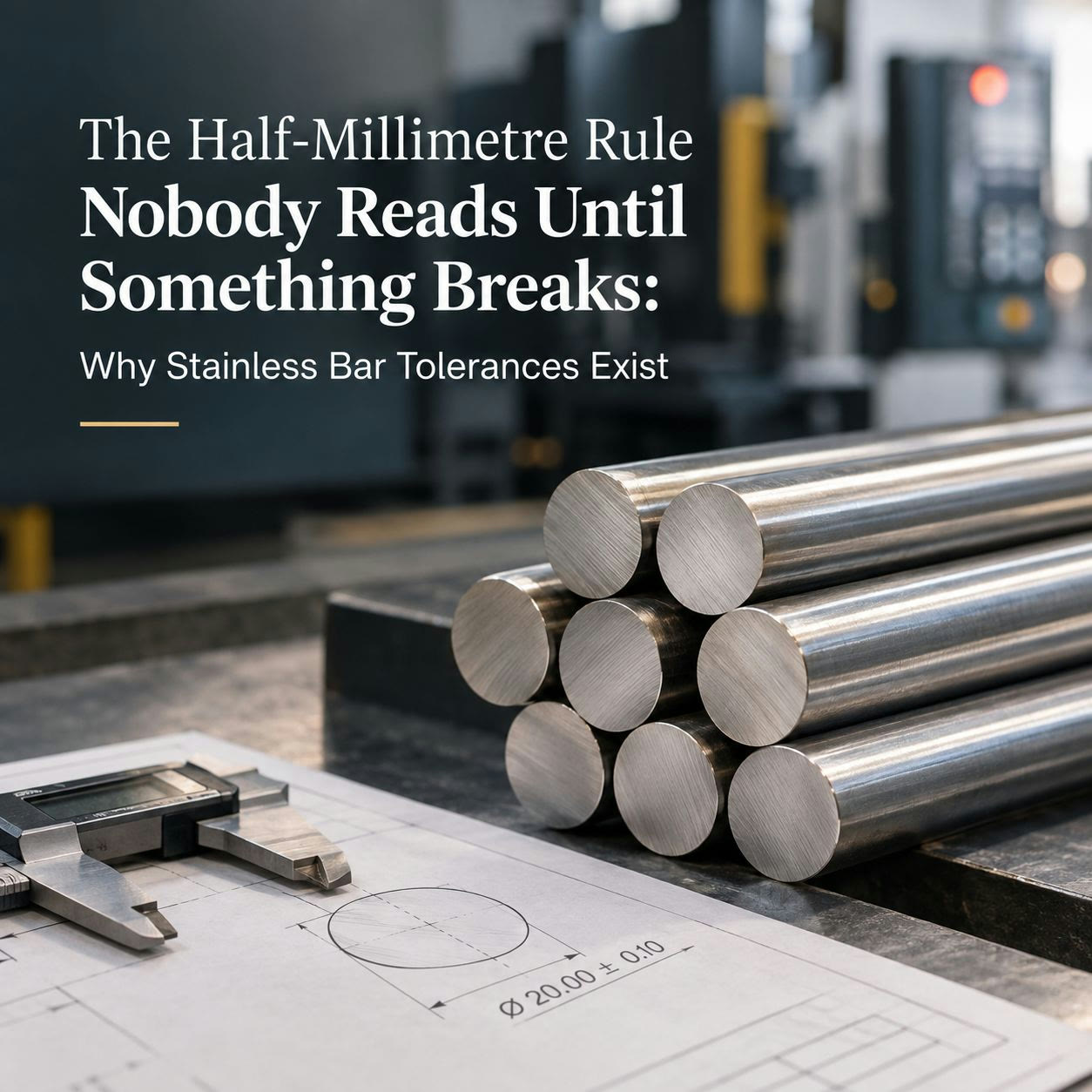
Every stainless steel bar that leaves a mill carries an invisible contract. It’s written into a document most have never opened: ASTM A484, the standard that governs dimensional tolerances for stainless steel bars — diameter, out-of-round, straightness. It reads like the driest kind of fine print and exists entirely because of jammed machines.
What the standard actually promises
It’s worth being precise about what a tolerance standard is, because it’s usually misunderstood. A484 doesn’t promise a perfect bar. No mill can produce a bar that is exactly 20.000mm in diameter, dead straight, for the full length of a six-metre length, every single time. What A484 promises instead is a band — a defined range within which every dimension has to fall, batch after batch. Precision in manufacturing is not about eliminating deviation, it’s about keeping deviation small enough that it becomes invisible.
Where the problem actually shows up
On the production floor, automatic bar-feed systems on CNC lines are built to run stock unattended, feeding one length after another into a machine without a person checking each piece by hand. These systems are calibrated to a tolerance band — they expect some variation, but only within limits.
A bar that’s even slightly over spec doesn’t get flagged politely. It jams the feeder mid-cycle. The line stops. None of it is a dramatic failure — it’s a small, silent cost that adds up across a shift, a week, a production quarter, without ever showing up as a single line item anyone can point to.
Out-of-round is a subtler version of the same problem. A bar that’s technically within its diameter spec but not round — slightly oval rather than circular — can still run through a feeder without jamming, and still throw off a tight-tolerance turned part downstream. The lathe chuck grips an imperfect circle, the part comes out eccentric, and nobody traces it back to the raw material until several failed parts later.
Why the standard is the floor, not the ceiling
This is why serious buyers and serious mills tend to talk about tolerance the same way: the number in the standard is the minimum acceptable outcome, not the target to aim for. A mill that treats A484 as the ceiling — cutting it as close as legally defensible — is optimizing for passing an audit, not for how the material actually behaves once it’s out of their hands and into someone else’s machine.
The quieter cost: trust, not just downtime
There’s a second cost that’s easy to miss, because it doesn’t show up as a stopped machine. It shows up as a habit. Once a buyer has been burned by an out-of-spec batch, they stop trusting the paperwork and start re-inspecting everything that arrives — every bar, every batch, regardless of the certificate attached to it. That’s an expensive habit to build into a procurement process, and once it’s there, it rarely goes away just because the next few batches are fine.
A tolerance standard, in that sense, isn’t really a technical document. It’s a mechanism for letting two parties who’ve never met trust each other’s material sight unseen. That’s what A484 is actually buying a buyer: the ability to order bar stock and not personally check every piece for straightness before it goes anywhere near a machine.
The pattern worth noticing
Almost every dimensional standard in this industry follows the same origin story, even when the specific numbers differ: someone, somewhere, had a problem repeat often enough that it got written down as a rule instead of being re-solved from scratch every time. ASTM A276 covers general bar and shape tolerances. EN 10059 and EN 10060 do similar work for square and round bars in European specification systems. Different documents, same underlying instinct — codify the failure so the next generation doesn’t have to rediscover it the hard way.
That’s worth remembering the next time a tolerance clause looks like bureaucratic fine print. It probably started as somebody’s very bad Tuesday.